Kolkata & Howrah, West Bengal Consultations by appointment
MODERN SURGICAL TECHNOLOGY

Robotic & Minimal Access Surgery

A guide to how robotic and laparoscopic surgery work, what they may offer, and how the right approach is chosen for each patient.

Not every patient or condition requires robotic surgery. The appropriate technique is decided after clinical assessment.

Two ways of operating through small incisions

What is robotic surgery?

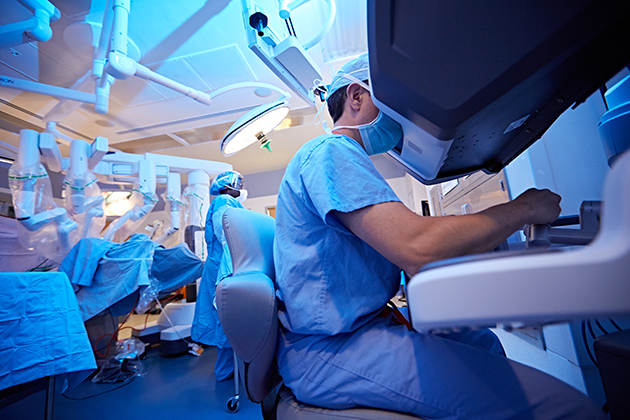
In robotic surgery, the surgeon operates from a console next to the patient, controlling slim instruments and a high-definition 3D camera mounted on robotic arms. The robot does not act on its own; every movement is made by the surgeon.

What is laparoscopic surgery?

In laparoscopic (keyhole) surgery, the surgeon inserts a camera and long, thin instruments through small incisions and operates while watching a screen. It is widely used for gallbladder, hernia, appendix and many gastrointestinal procedures.

How Robotic Surgery Works

The surgeon is in control at every step

  1. Step 1

    Small incisions

    A few small openings are made for the camera and instruments.

  2. Step 2

    Robotic arms positioned

    The arms hold the camera and instruments steady inside the body.

  3. Step 3

    Surgeon at the console

    The surgeon views a magnified 3D image and controls each instrument.

  4. Step 4

    Surgical team at the bedside

    A trained team stays with the patient throughout the operation.

Potential Advantages

What minimally invasive surgery may offer

  • Smaller incisions and smaller scars
  • Magnified, high-definition view of the operating field
  • Fine, stable instrument movement in tight spaces
  • Possibly less pain and a shorter hospital stay
  • Possibly an earlier return to normal activities

Benefits vary between patients and procedures and are not guaranteed.

Who May Be Suitable

Suitability is decided case by case

Your surgeon considers your condition, general health, previous abdominal surgery, body weight and the complexity of the procedure. For some patients, laparoscopic or open surgery is the safer or more appropriate choice.

Conditions that may be treated

Comparison

Robotic vs laparoscopic vs open surgery

Robotic Laparoscopic Open
Incisions Several small incisions Several small incisions One larger incision
View Magnified 3D, surgeon-controlled camera Magnified 2D or 3D on a screen Direct view
Instruments Wristed instruments controlled from a console Long, straight hand-held instruments Hand-held instruments
Typical recovery Often shorter than open surgery Often shorter than open surgery Usually longer
Best suited to Selected procedures after assessment Many routine and advanced procedures Complex cases or where keyhole is not suitable

Frequently asked questions

Does the robot perform the operation?

No. The surgeon controls every movement of the instruments from the console throughout the procedure.

Is robotic surgery safe?

Like all surgery, it carries risks. Your surgeon will explain the risks and benefits for your specific procedure.

Is robotic surgery more expensive?

It is often more expensive than laparoscopic surgery. The hospital can provide an estimate for your procedure.

Can every operation be done robotically?

No. Many procedures are best done laparoscopically or by open surgery. The technique is decided after clinical assessment.

Find out whether robotic surgery is suitable for you

Bring your reports to a consultation to discuss the options for your condition.

Book an Appointment